Introduction
The flow and packing characteristics of pharmaceutical powders play a critical role in tablet compression, capsule filling, blending, and packaging operations. One of the most widely accepted methods for evaluating these properties is the determination of bulk density using the Scott Volumeter, described in USP General Chapter <616>, Bulk Density and Tapped Density of Powders. The Scott Volumeter provides a standardized method for measuring the bulk density of powders by allowing material to flow under controlled conditions into a precisely defined measuring cup. By minimizing operator variability and controlling powder presentation, the Scott Volumeter produces highly reproducible results that are valuable during formulation development, process validation, and routine quality control.
Why Bulk Density Matters
Bulk density is defined as the ratio of the mass of an untapped powder to the volume it occupies, including the spaces between individual particles. Because these interparticle voids are influenced by particle size, shape, moisture content, and handling history, bulk density provides important insight into a powder’s physical behavior.
Knowledge of bulk density is essential for designing manufacturing processes, selecting processing equipment, calculating container fill volumes, and predicting blending and die-filling performance. Variations in bulk density can affect tablet weight uniformity, capsule fill consistency, and overall manufacturing efficiency. Since powder handling can alter particle packing, USP <616> emphasizes that the method used to determine bulk density must always be specified when reporting results.
The Scott Volumeter Principle
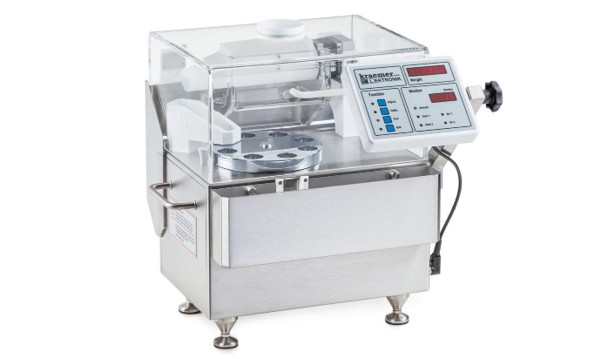
The Scott Volumeter, identified as Method II in USP <616>, is designed to provide a controlled and repeatable method of filling a measuring cup with powder. The apparatus consists of a top funnel fitted with a 1.0-mm sieve, a series of four glass baffle plates contained within a baffle box, and a lower funnel positioned above a precision measuring cup.
As the powder passes through the sieve, it flows over the glass baffles, where it repeatedly slides and bounces before entering the measuring cup below. This controlled cascade minimizes powder compaction while promoting uniform filling. Excess powder is then carefully removed with a straight-edged spatula without disturbing the powder bed, and the filled cup is weighed. Because the cup volume is precisely known, the bulk density is easily calculated by dividing the powder mass by the cup volume. USP specifies that the determination be performed using three separate powder samples and that the average value be reported.
Advantages of the Scott Volumeter
Compared with simple graduated-cylinder methods, the Scott Volumeter offers several advantages. The controlled powder flow reduces the influence of operator technique and produces more consistent packing from one determination to the next. The apparatus also minimizes localized compaction that can occur when powders are manually poured into measuring cylinders.
These features make the Scott Volumeter particularly valuable for powders that exhibit irregular flow behavior or are sensitive to handling. Because the method standardizes powder presentation before measurement, laboratories can obtain highly reproducible results that are suitable for product development, quality control, and regulatory documentation.
Relationship to Powder Flow Properties
Although the Scott Volumeter measures only bulk density, the resulting data become even more valuable when combined with tapped density measurements. The difference between bulk and tapped density reflects the degree of interparticle interaction within the powder bed. Powders that exhibit large differences between these values typically possess poorer flow characteristics and greater compressibility.
USP <616> uses these measurements to calculate two widely accepted indicators of powder flowability: the Compressibility Index (Carr’s Index) and the Hausner Ratio. Lower differences between bulk and tapped density generally indicate better flow, while larger differences suggest increased particle cohesion and reduced flowability. These parameters are widely used during formulation development to predict manufacturing performance and optimize powder blends.
Applications in Pharmaceutical Manufacturing
The Scott Volumeter is routinely used throughout the pharmaceutical industry to characterize raw materials, active pharmaceutical ingredients (APIs), excipients, granulations, and finished powder blends. Bulk density measurements support equipment selection, hopper design, die-fill optimization, capsule filling, packaging calculations, and process validation.
Because the method is standardized by USP, it also provides a common basis for comparing material properties between manufacturing sites, suppliers, and development laboratories. Consistent bulk density data contribute to improved process control and help ensure uniform product quality throughout commercial production.
Conclusion
The Scott Volumeter remains one of the most reliable and reproducible methods for determining the bulk density of pharmaceutical powders. By controlling powder flow through a standardized system of funnels, baffles, and calibrated measuring cups, the instrument minimizes operator variability and produces consistent measurements that support formulation development and quality assurance. When used in accordance with USP General Chapter <616>, the Scott Volumeter provides critical information about powder behavior that helps manufacturers optimize processing conditions, improve product consistency, and maintain compliance with pharmacopeial standards.